
TradebyBartr is revolutionizing commerce in Nigeria by enabling cashless exchange of goods and services through a modern barter platform. Designed for students, small business owners, and community members who face cash flow constraints, TradebyBartr's mission is to democratize access to essential goods and services without requiring money. Using a mobile-first approach with smart matchmaking, community-driven trust networks, and AI-powered trade facilitation, TradebyBartr makes bartering easier, safer, and built for the digital age.
...making cashless exchange as intuitive as modern e-commerce.

Nigeria's economic landscape presents unique challenges: with over 40% of the population living below the poverty line and youth unemployment exceeding 30%, traditional commerce often excludes those who need it most. Meanwhile, households accumulate unused items worth billions of Naira annually, and skilled professionals struggle to monetize their expertise without upfront capital.
The Barter Revival
While bartering is deeply rooted in Nigerian culture, it remained fragmented, informal, and limited by geography. The COVID-19 pandemic further highlighted the need for alternative economic models as cash became scarce and digital solutions gained acceptance.
Research revealed three critical gaps in the Nigerian market:
No trusted digital barter platform - Existing solutions were either too complex, lacked verification, or focused solely on high-value B2B exchanges
Community fragmentation - Users wanted to trade within trusted networks but had no organized way to do so
Value matching challenges - Direct 1:1 trades rarely worked, creating friction
The Vision
TradebyBartr was conceived as Nigeria's first comprehensive barter ecosystem, combining the trust of community-based trading with the convenience of modern e-commerce, all accessible from a smartphone.
Project Timeline: 8 months from research to beta launch
Team: 1 Product Designer (me), 2 Developers, 1 Product Manager
Platform: Responsive web application (mobile-first), with native apps planned for Phase 2
Lead Product Designer | End-to-End Design Ownership
As the sole product designer on TradebyBartr, I was responsible for the complete user experience—from initial research through implementation and iteration.
Core Responsibilities:
Research & Strategy
Conducted competitive analysis of different marketplace and barter platforms
Synthesized findings into actionable personas and journey maps
Defined information architecture and feature prioritization
Design Execution
Created comprehensive design system with components, patterns, and documentation
Designed 100+ screens spanning authentication, onboarding, trading, messaging, communities, and gamification
Prototyped key user flows for usability testing
Ensured accessibility compliance (WCAG 2.1 AA standards)
Collaboration & Iteration
Worked closely with developers to ensure design feasibility and pixel-perfect implementation
Conducted 4 rounds of usability testing with 35+ participants
Iterated based on user feedback and analytics data
Facilitated design critiques and stakeholder presentations
Identifying the Gap: Where Cash Fails, Barter Can Thrive
Through market research and user interviews, I identified four converging opportunities that made TradebyBartr uniquely positioned to succeed:
Opportunity 1: The Underserved Majority
58 million Nigerians live on less than $1.90/day, yet possess valuable assets and skills
Students accumulate books, electronics, and clothing they no longer need
Small business owners have excess inventory but lack working capital
Skilled workers (designers, writers, tutors) have time but limited clients
"I have so many textbooks from last semester just sitting there. I could use a laptop charger, but I can't afford to buy one right now." — Chinedu, University of Lagos student
Opportunity 2: Community-Driven Trust
Nigerians prefer trading within known networks (family, church, school)
Existing platforms lacked community features, forcing users to vet strangers
Opportunity to create "digital villages" where trust scales organically
Opportunity 3: Regulatory Advantages
Barter transactions in Nigeria aren't subject to payment gateway fees or taxation complexities
No need for banking infrastructure integration (major barrier removed)
Government support for alternative economies and youth entrepreneurship

21 year old University Student
(Computer Science)
About
Meet Chinedu, a determined Computer Science student at the University of Lagos. With a monthly allowance of ₦50,000 that barely covers rent, food, and transport, Chinedu is always looking for creative ways to stretch his budget. He has accumulated textbooks, electronics, and gadgets from previous semesters that sit unused in his hostel room, yet he constantly needs new items like chargers, course materials, tech accessories; that he can't afford to buy. Active on social media and comfortable with mobile apps, Chinedu represents the digitally-native generation that's ready to embrace alternative ways of accessing value without draining their limited cash reserves.
Goals
Get required textbooks and course materials for each semester without spending all my allowance.
Exchange gadgets and electronics I no longer use for items I actually need right now
Find people within my university community who have what I need and are willing to trade.
Build a reputation as a reliable trader so I can access better exchange opportunities.
Earn some form of value/credits through activities that don't require upfront cash.
Frustrations
Posts "For Sale/Exchange" messages in university WhatsApp groups with hundreds of members.
Checks campus notice boards and asks friends if they know anyone trading specific items.
Misses out on potential trades because there's no organized way to discover who has what he needs.
Relies on roommates and coursemates for informal item swaps with no documentation or rating system.

32 year old Graphic Designer
About
Meet Jade, a talented freelance graphic designer and photographer juggling multiple clients and projects. Her income fluctuates wildly—some months he earns ₦250,000, other months barely ₦80,000, making it difficult to plan major purchases like the laptop upgrade she desperately needs or the home office furniture that would improve her productivity. Between client projects, Jade has idle hours she could monetize, and she possesses professional equipment (cameras, lighting) that sit unused during slow periods. She's resourceful and sees time as her most valuable asset, if she can trade her skills for goods and services instead of cash, she preserves her limited savings while still accessing what she needs. Jade values professional relationships and understands that strategic bartering can also serve as portfolio-building and networking opportunities.
Goals
Trade my professional services (design, photography) for tech equipment, home office items, and everyday needs.
Fill gaps between paid client projects with valuable barter work that builds my portfolio.
Connect with other creatives and professionals for skill-swap collaborations (I design, you code my website).
Access premium/professional items (laptops, monitors, software) without the ₦300,000+ cash outlay.
Build a reputation as a reliable service provider so I can access higher-value trade opportunities through auctions
Frustrations
Trades services with fellow freelancer friends informally, but the network is limited and exchanges are untracked
Uses OLX/Jiji only for cash sales of used equipment, never considers it for bartering services
Proposes barter arrangements to existing clients on a case-by-case basis (uncomfortable to bring up, feels unprofessional)
A guided multi-step flow that collects essential information without overwhelming new users. The goal: get users from signup to their first meaningful action in under 2 minutes.


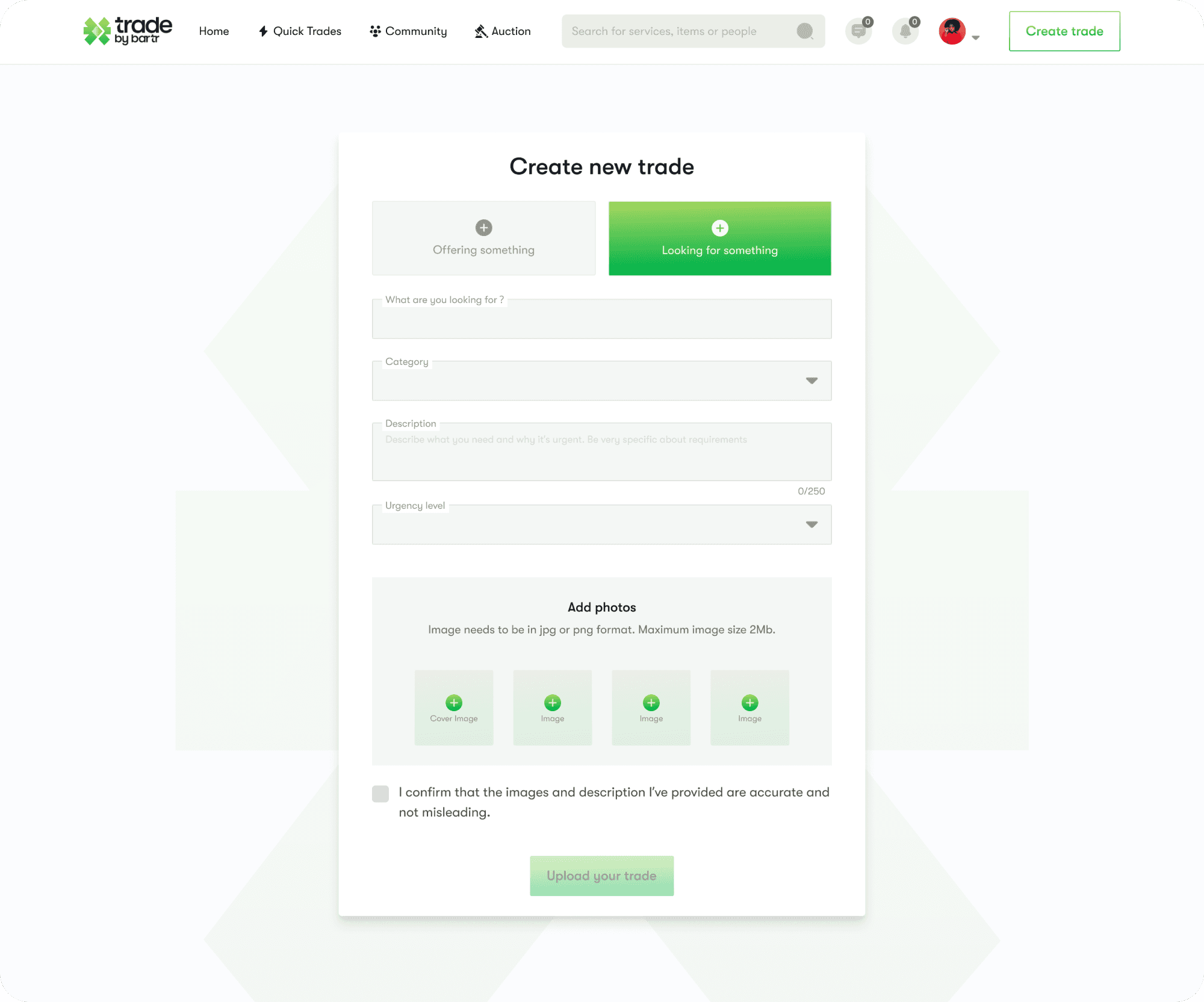
Streamlined posting experience with smart categorization, image uploads, and optional urgency levels for Quick Trades. Users can clearly specify what they're offering and what they want in return, with built-in prompts to improve listing quality. The flow reduces friction while ensuring listings contain enough detail to match effectively.

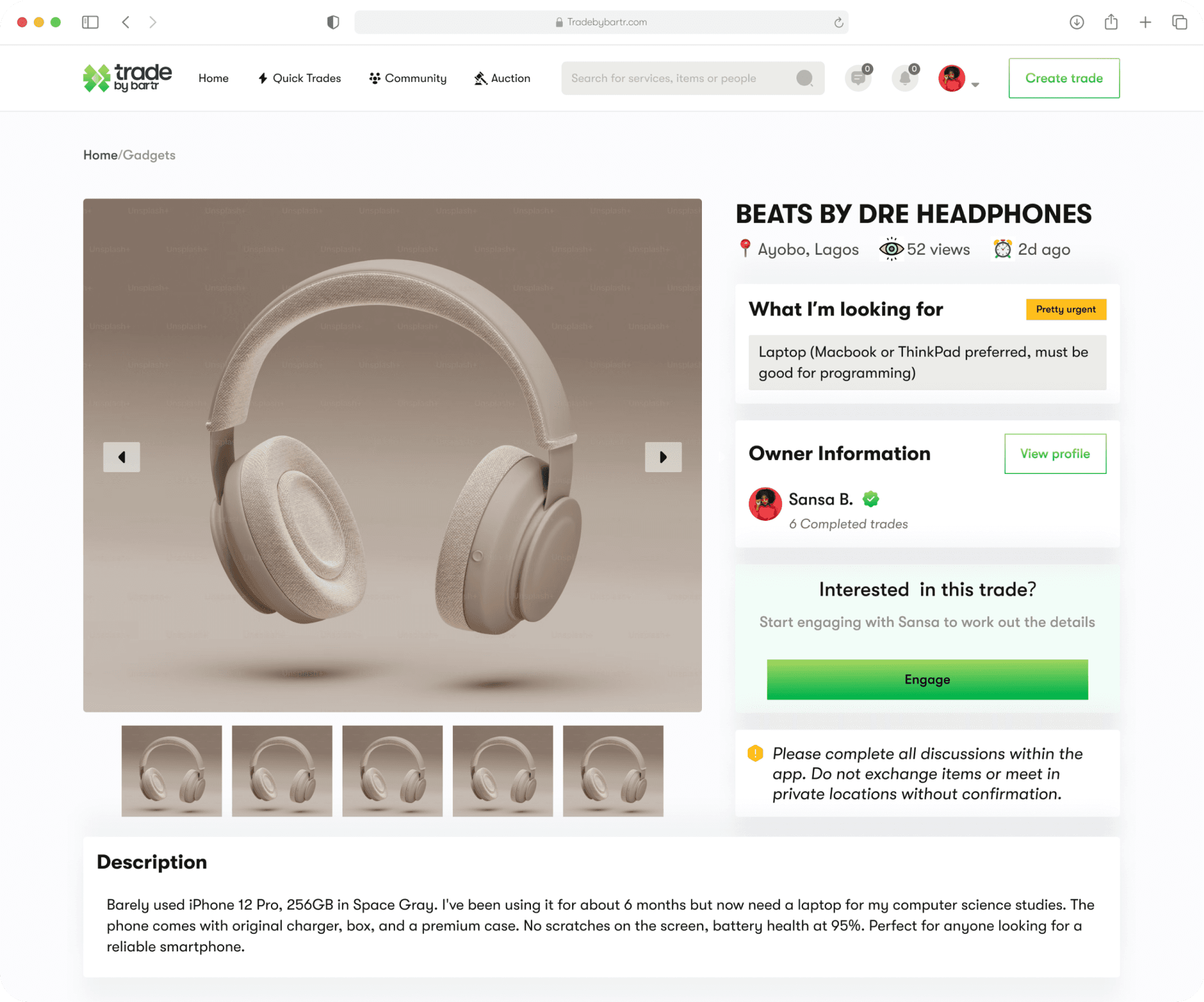
Smart search and filtering system that surfaces relevant trades through categories, communities, and urgency indicators. Users can browse their feed, search specific items, or filter by location and community. One-tap interest expression and in-app messaging keep the discovery-to-negotiation journey seamless.

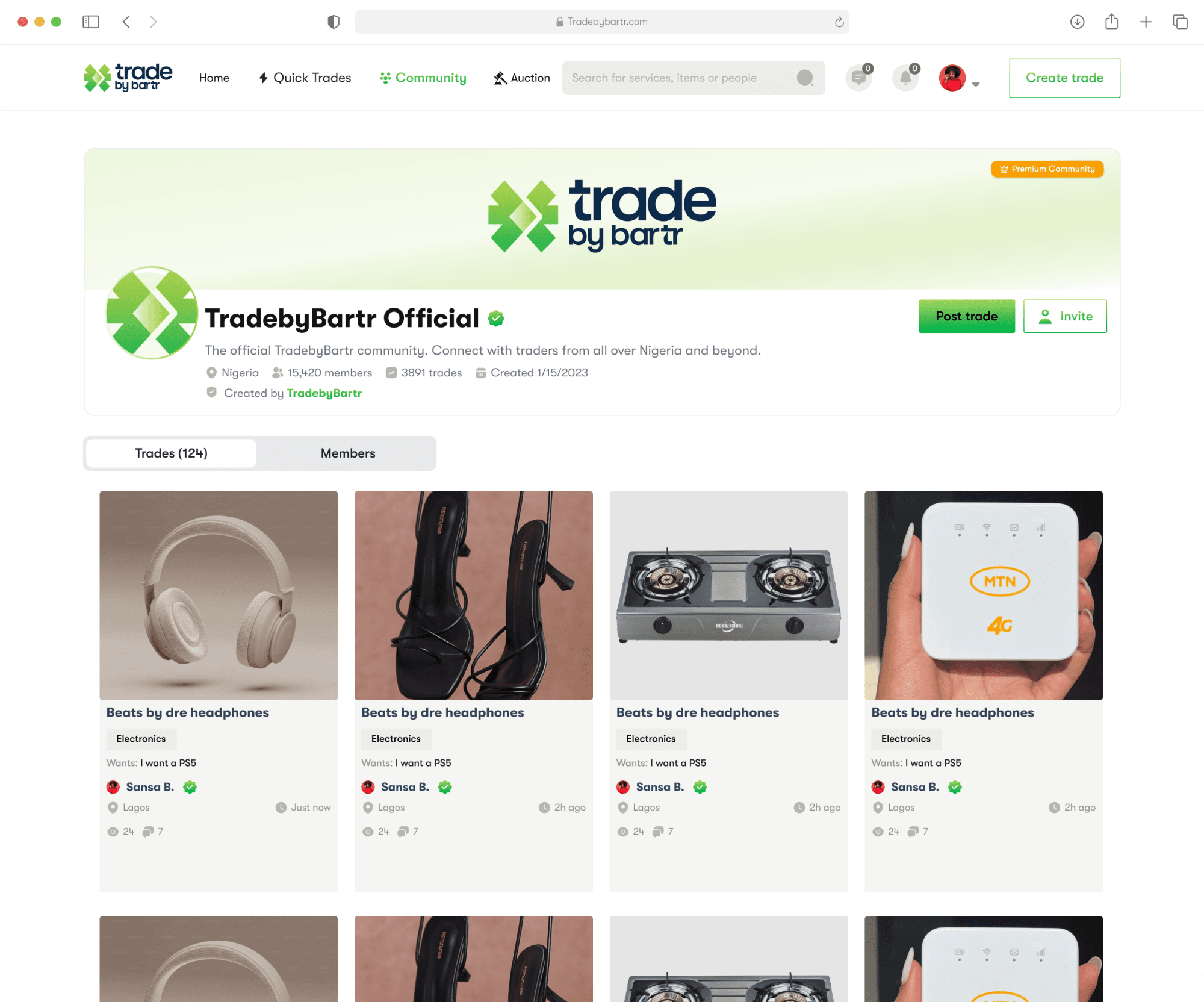
Join and Engage in Community
Smart search and filtering system that surfaces relevant trades through categories, communities, and urgency indicators. Users can browse their feed, search specific items, or filter by location and community. One-tap interest expression and in-app messaging keep the discovery-to-negotiation journey seamless.



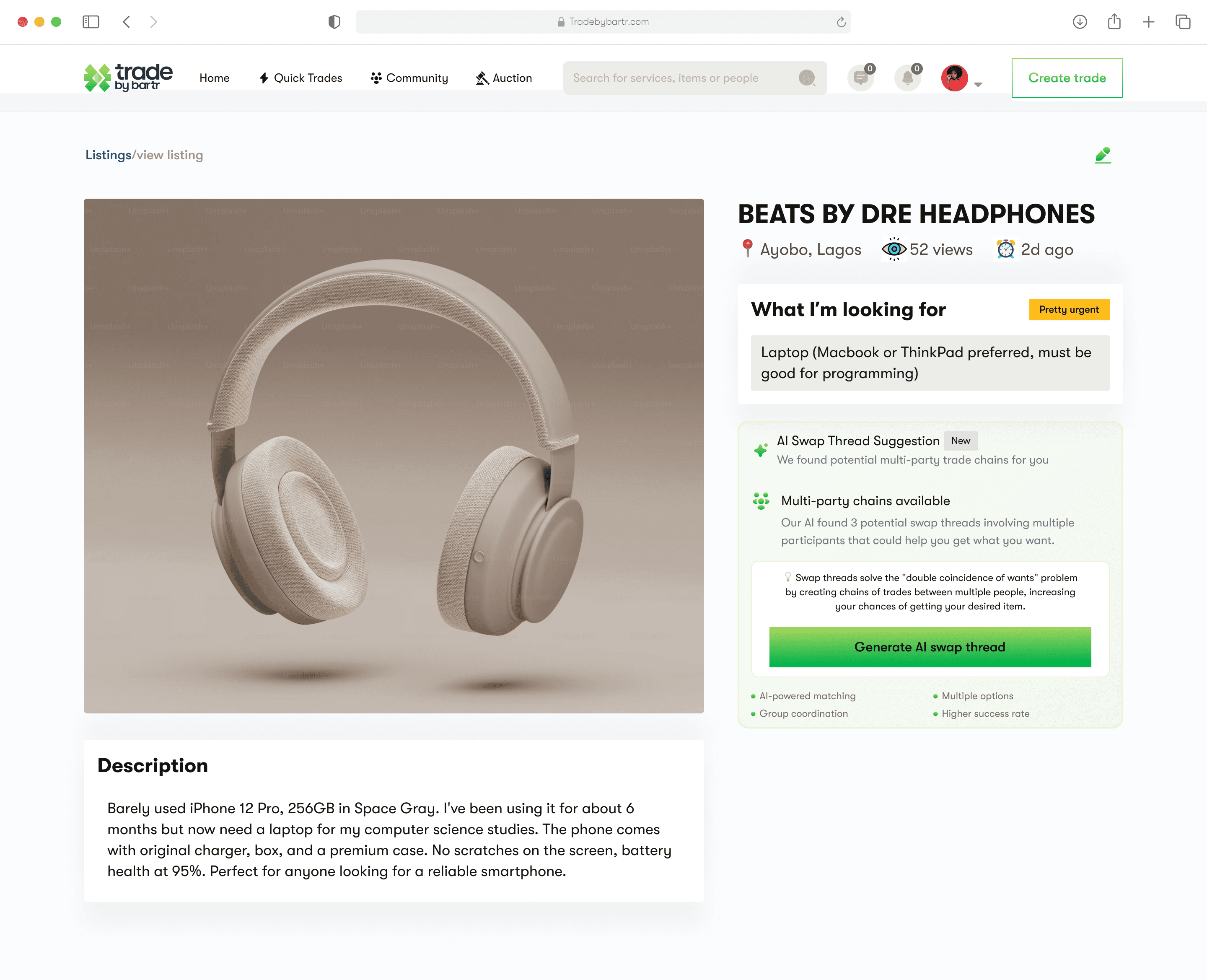
Swap Threads
AI-powered multi-party trade matching that solves circular exchange scenarios. When a user can't find a direct match, the system identifies chains where multiple people swap items in sequence, ensuring everyone gets what they want. The flow visualizes the thread, shows each participant's role, and coordinates the complex exchange—making the impossible possible.

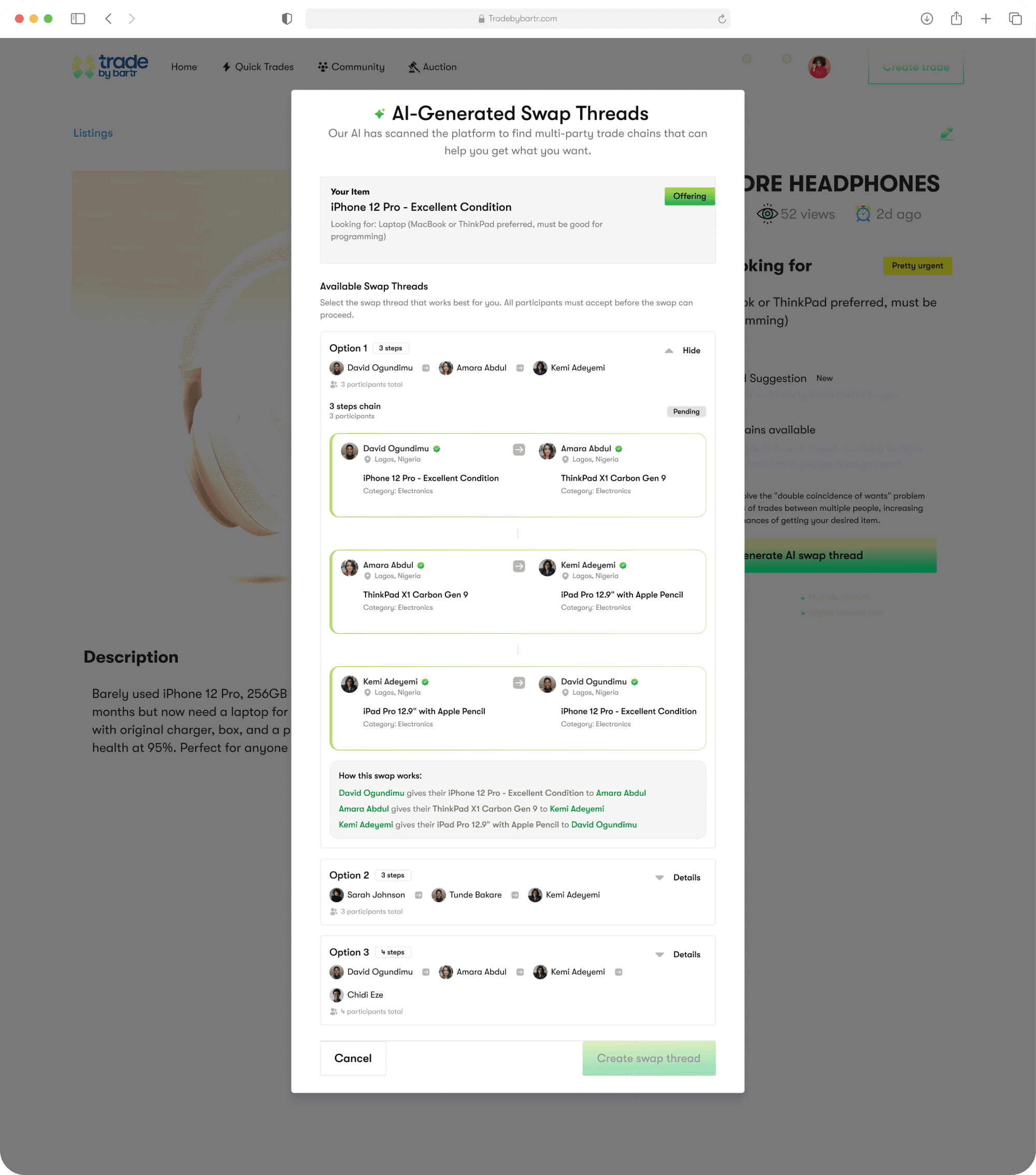


raditional bartering is limited to simple one-on-one exchanges, which creates fundamental barriers: finding direct matches is rare, values rarely align perfectly, and trading with strangers feels risky. Through extensive research and iterative design, TradebyBartr evolved beyond these limitations to reimagine what modern bartering could be.
The platform introduces innovative solutions that address real user pain points; Swap Threads that enable multi-party trade chains when direct matches don't exist, Bartr Credits that bridge value gaps without requiring cash, Communities that establish trust networks for safer trading, and Quick Trades with urgency levels for time-sensitive needs. These weren't arbitrary features; each directly responded to barriers preventing users from bartering at all.
By grounding our design decisions we created a platform that transforms bartering from a frustrating one-to-one transaction into a dynamic ecosystem where everyone can participate, regardless of whether they have a perfect match.
TradebyBartr proves that with the right technology and user-centered design, we can revive an ancient exchange model for modern contexts, especially in markets like Nigeria where cash flow is limited but valuable goods and skills are abundant. The result is a platform that doesn't just facilitate trades; it builds trusted communities and unlocks value that would otherwise remain inaccessible.